Place of Origin:
China
Brand Name:
ANNEC
Certification:
ISO
Model Number:
Customized
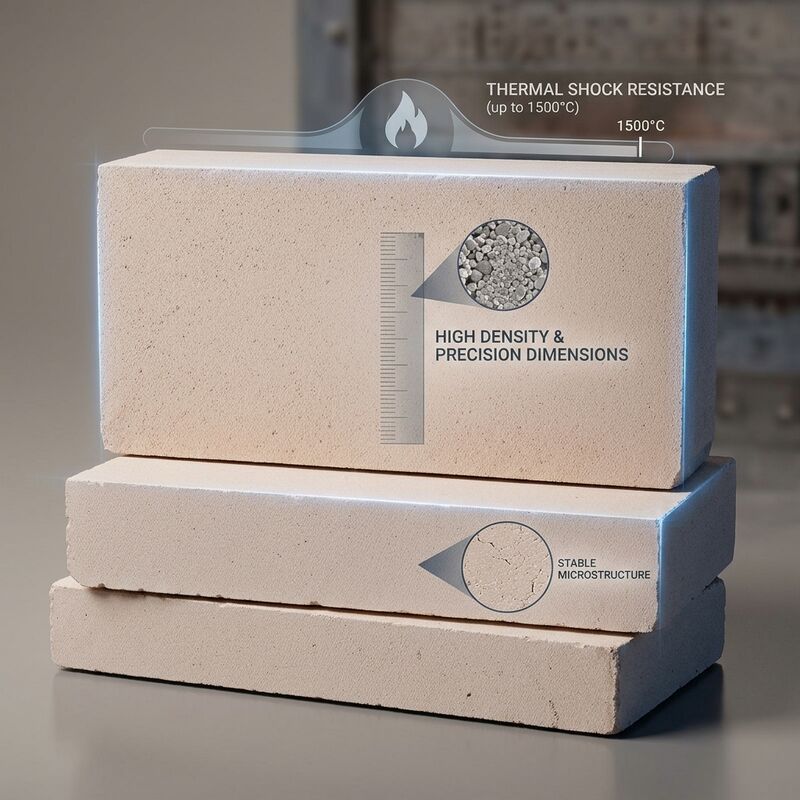
Insulating fire clay bricks are the workhorse lining material of industrial heat processing equipment, and this 230x114x73mm clay refractory brick is engineered for furnace builders and maintenance contractors who need predictable thermal behaviour rather than a single headline number. The brick is pressed from fireclay with an alumina content between 30% and 45%, silica between 50% and 65% and iron oxide below 2%, then fired to a bulk density of 2.1 to 2.2 g/cm³. That density window keeps the brick light enough for large lining areas and for insulating backup courses, while still carrying a cold crushing strength of ≥40 MPa so the lining survives handling, transport and mechanical load during installation.
The combination of a creep rate of ≥1350°C and a refractoriness under load value of ≥1280°C is what separates a dependable clay brick from a low cost substitute. Under sustained load at working temperature, a brick with a low creep resistance deforms slowly, the lining settles, joints open and the furnace shell begins to run hot. This grade holds its dimensional stability through long campaigns, which is why it is widely specified for reheating furnace liners, soaking zone walls and other continuous duty positions where shutdowns are expensive.
Key Features| Parameter | Specification |
|---|---|
| Product Name | Insulating Fire Clay Brick |
| Shape | Brick |
| Standard Size | 230 x 114 x 73 mm |
| Bulk Density | 2.1 - 2.2 g/cm³ |
| Cold Crushing Strength | ≥40 MPa |
| Modulus of Rupture | 70 - 80 |
| Creep Rate | ≥1350°C |
| Refractoriness Under Load (PLC) | ≥1280°C |
| Chemical Composition | Al2O3 30-45%, SiO2 50-65%, Fe2O3 <2% |
| Thermal Shock Resistance | Good |
| Application | Reheating furnace |
| Usage | Furnace liner |
| Place of Origin | China |
The most common position for this grade is the working lining of reheating furnaces, where billets and slabs are brought to rolling temperature and the brick face is exposed to radiant heat, scale dust and periodic door openings. The same property set suits soaking pit walls, annealing furnace linings, forge furnace hearths and the backup courses behind denser hot face bricks. In chimneys, flues and hot gas ducts the brick provides thermal insulation together with enough structural integrity to support its own weight over long vertical runs.
Because the bricks are available in standard 230x114x73mm units as well as customized dimensions and special shapes, they can be ordered as a complete set for a furnace reline, including curved bricks for burner ports, skewbacks for arches and cut pieces for expansion joints. Contractors working to tight maintenance windows value the consistent dimensional tolerance because it keeps the mortar joint thickness uniform and shortens dry out time.
Packaging & Quality AssuranceBricks are stacked on fumigated wooden pallets, strapped and shrink wrapped, then loaded into containers with corner protection to limit chipping in transit. Every production batch is checked for bulk density, cold crushing strength and chemical composition, and inspection records can be issued together with the shipping documents on request. The material is manufactured under an ISO certified quality system, and technical support is available during lining design so that brick grade, joint thickness and expansion allowance are matched to your furnace operating profile.
Send your inquiry directly to us